Lewis O. Harvey, Jr.
Amendment I: Congress shall make no law respecting an establishment of religion, or prohibiting the free exercise thereof; or abridging the freedom of speech, or of the press; or the right of the people peaceably to assemble, and to petition the government for a redress of grievances. (click here). Humata, Hukhta, Huvarshta.
Course Offerings and Ratings
Revised on Sunday, 23 January, 2022 10:13
Psychology of Perception: PSYC 4165 (4 hours credit)
Three hours of lecture and one three-hour laboratory meeting per week in the Spring and Fall. We study the peripheral and central mechanisms involved in the generation of perceptual experience. Special attention is given to vision and audition. Major theories in these areas are examined. Students carry out research projects in the laboratory section. Students are required to have problem-solving skills, especially using algebra and statistics.
| Prerequesites: | PSYC 1001, PSYC 2111 and PSYC 3111 |
| Last Offered: | Fall 2021 |
| Currently Offered: | Not Offered |
| Next Offered: | |
| Previous Course Pages |
Psychology of Perception: PSYC 4165-581 (Online Version)
| Prerequesites: | PSYC 1001 and PSYC 3101 |
| Last Offered: | Summer 2016 |
| Currently Offered: | Not Offered |
| Next Offered: | Not Offered |
| Previous Course Pages |
Proseminar in Cognitive Psychology, Module 2, Perceptual Processes: PSYC 5665-002
Advanced survey of topics in sensory processing and perception. General areas include signal detection theory, perceptual processing, pattern and object recognition, history, theory and the search for latent variables.
| Prerequesites: | Enthusiasm and clear thinking |
| Last Offered: | Fall 2018 |
| Currently Offered: | Fall 2020 |
| Next Offered | To be determined |
| Previous Course Pages |
Modern Psychometric Methods in R: PSYC 4541-002/5541-802 (3 credit hours)
The course is built around Patrick Mair’s book of the same title. What will be covered will depend who is enrolled in the class. Ideally the students would have some particular data analysis problem that they would like to solve. These problems would determine what we would actually do in the during the semester. The overarching theme is Latent Variables and Where to Find Them (thank you J. K. R.). Searching for latent variables covers a wide range of topics, most of them not usually discussed under one conceptual framework: e.g., signal detection theory, test-item analysis, optimized scaling analysis, path analysis, factor analysis, structural equations, preference analysis and multidimensional scaling analysis. The course is aimed at smart, curious, intellectual active advanced undergraduates and honors students working on their data analyses for Spring 2020 as well as graduate students who are interested in expanding their skills in advanced data analysis relevant to their research projects.
| Prerequesites: | Enthusiasm and clear thinking |
| Last Offered: | Spring 2020 |
| Currently Offered: | Not Offered |
| Next Offered | To be determined |
| Previous Course Pages |
Psychology of Æsthetic Judgment: PSYC 4541/5541-005 (3 credit hours)
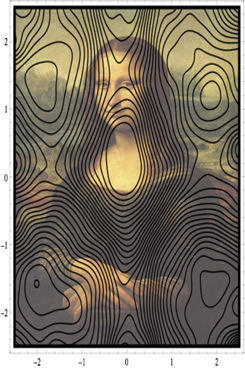
This course will explore the psychological and neural bases of aesthetic judgments in photography, painting, and music. You will read and report on primary journal papers. You will search the scientific literature for additional articles relevant to topics that are of interest to you. You will design and conduct an experiment of your choice to explore current ideas and test hypotheses. This course is open to advanced undergraduates and graduate students.
| Prerequesites: | Enthusiasm and clear thinking |
| Last Offered: | Spring 2018 |
| Currently Offered: | Not Offered |
| Next Offered | To be determined |
| Previous Course Pages |
Applied Multidimensional Scaling: PSYC 4541/5541 (3 credit hours)
In this course you will learn how to apply the powerful techniques of multidimensional scaling to psychological data. You will learn how to use the smacof package in the open source R Projecet for Statistical Computing software. You will read original journal articles and analyze data sets of others and of your own. The precise type of psychological data we examine will depend on the interests of the students in the class. experiments of their choice to explore current ideas and hypotheses. This course is open to advanced undergraduates and graduate students.
| Prerequesites: | Enthusiasm and clear thinking |
| Last Offered: | Spring 2016 |
Currently Offered: |
Not Offered |
| Next Offered | To be determined |
| Previous Course Pages |
Cognitive Lunch: PSYC 6605
Cognitive Lunch is designed to bring everyone up to date on the latest ideas and findings in the Program, the Department and the Profession. It is a combination of graduate student presentations and faculty-lead discussions of important issues
| Prerequesites: | Enthusiasm and clear thinking |
| Last Offered: | Spring 2016 |
| Currently Offered: | 2016–2017 Academic Year |
| Next Offered | Fall 2017 |
General Psychology: PSYC 1001-4
Three hours of lecture and one hour of recitation per week. The course surveys major topics in psychology: perception, development, personality, learning and memory, and biological bases of behavior. Students participate for several hours as subjects in ongoing research.
| Prerequesites: | None |
| Last Offered: | Spring 1996 |
| Currently Offered: | Not Offered |
| Next Offered | Not Planned |
Seminar in Cognitive Psychology: PSYC 7215-001
"Dynamical Cognitive Science: The Next Big Thing?"
Fall 2003, Wed, 10:00 to 12:30, MUEN D156
There are a wide variety of physical phenomena that show specific characteristic behavior that results from the dynamic interaction of many individual components (e.g., earthquakes, avalanches, quasars, stock price fluctuations, fractals) under conditions in which the system is neither in a state of equilibrium nor in a state of chaos. These systems are in a state that physicist Per Bak called self-organized criticality. Recent publications by, for example, David Gilden and by Larry Ward, assert that many psychological data show these same characteristic behaviors (e.g., 1/f cognitive noise), and that studying these phenomena will lead to deep insights into the operation of psychological mechanisms (e.g., attention and memory).
The seminar has three goals:
- To develop a deep understanding of the basic phenomena;
- To learn the techniques of data analysis appropriate to uncovering the phenomena in psychological data;
- To apply this analysis to specific data sets of psychological data that are of interest to each student.
Each participant in the seminar will make a presentation on a particular topic and will present the results of a “cognitive noise” analysis of an actual set of data from a psychological experiment. A paper based on the data analysis will be completed by the end of the seminar.
We will organize the seminar around Larry Ward’s recent book, which contains discussions of many areas of psychological research where these ideas may be appropriate:
Ward, L. M. (2002). Dynamical Cognitive Science. Cambridge, Massachusetts: The MIT Press.
Created with Dreamweaver on an M1 MacBook Pro